August 31, 2026
2026 Rose Rock Bridge Awardees Selected
Read blog post
Four Startups Selected to Solve Real-World Industry Challenges in Oklahoma
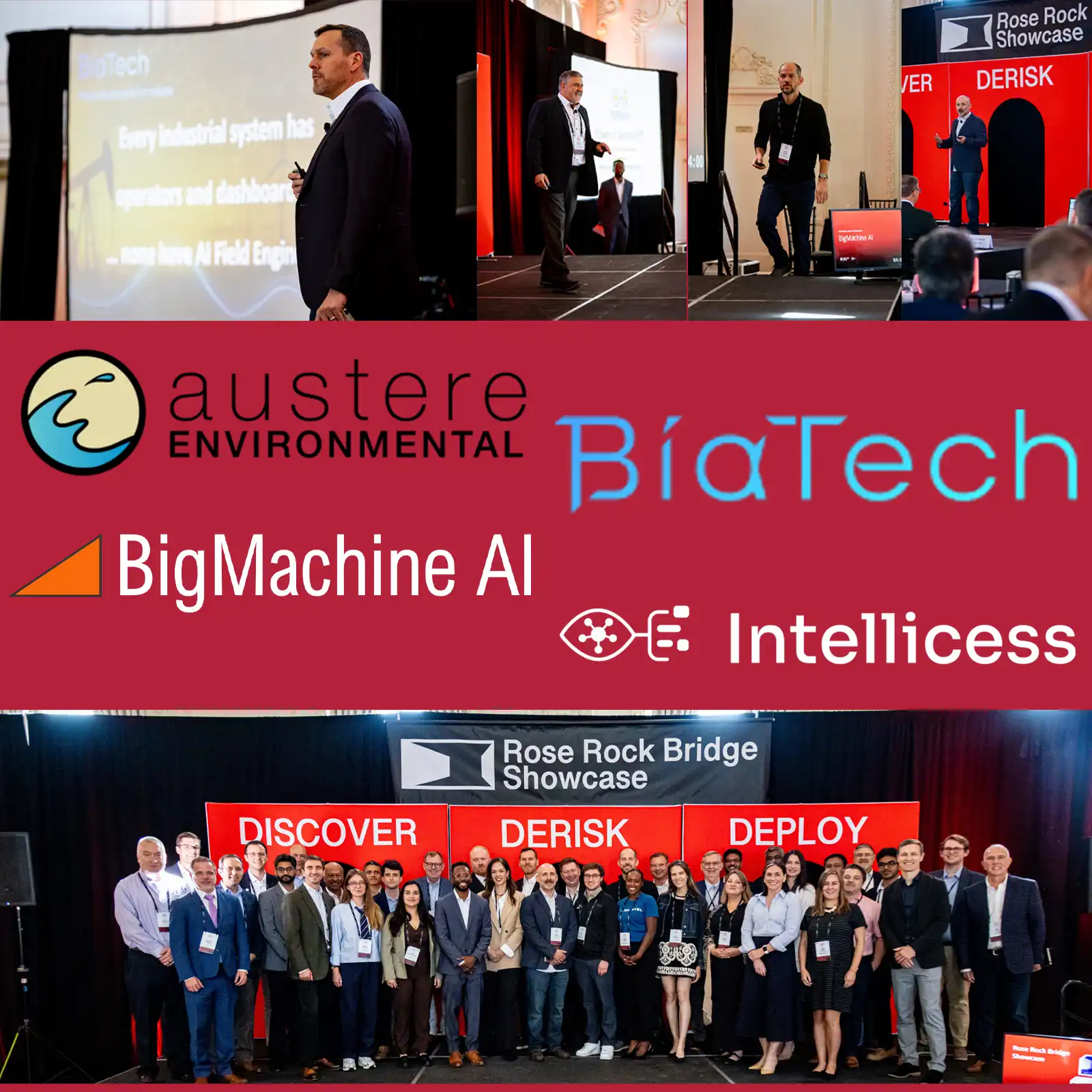
Four startups — coming from Colorado, Florida, and Texas — beat out 85 other applicants to land a spot in the program, a share of $400,000 in non-dilutive funding, and will establish a presence in Tulsa to pilot and advance their technologies over the next year.
These promising companies will get funding, mentorship, and — most importantly — real pilots with real industry partners instead of just another pitch competition trophy. This year's cohort has already raised over $2 million collectively and has piloted with energy majors before.
Over the next year, all four will set up shop in Tulsa, work alongside those industry partners, collaborate with the University of Tulsa, and help create more than 135 Oklahoma jobs. Here's who they are and what they're actually building.
Based in Golden, Colorado, Austere Environmental has a pretty simple pitch: drillers currently pay to haul away oil-contaminated soil as hazardous waste, even though that "waste" is usually 99% healthy dirt and less than 1% oil. Austere's machine separates the two — the clean soil goes back in the hole, and the recovered oil, diesel, and water get reused.
Their Remediation Unit recovers close to 100% of the fluids trapped in drill cuttings, cuts disposal costs by up to 83%, and can process 40 tons of drilling mud a day. Third-party testing from SGS and Pace Analytical backs up the claims — treated soil reportedly comes out three times cleaner than typical backyard dirt.
The origin story is the fun part: founder Dr. Curtis Purrington (a former Air Force F-16 crew chief and Space Resources PhD from Colorado School of Mines) originally built this tech to extract water from lunar soil for NASA. When he realized the same process could solve a very Earth-bound, very expensive problem in oil and gas, Austere was born. Shell is their lead investor.
BiaTech, out of Colorado, builds AI systems — they call the core engine "BiaLogic" — that pull in real-time data from siloed field equipment (SCADA, PLCs, IoT sensors, you name it) and turn it into something operators can actually act on. Think digital twins of energy assets, AI-powered field inspection tools, and edge hardware that can run analytics right at the wellsite instead of waiting on the cloud.
The company reports 90% prediction accuracy, a 15% productivity bump for clients, and over 500 TB of data processed across real-world deployments. One geothermal client is using BiaTech's flow-monitoring tech to figure out what's actually happening across miles of pipe they previously had no visibility into — which matters a lot when the goal is extending the life of expensive, hard-to-permit geothermal plants.
BigMachine, based in Texas, tackles a problem that's more universal in industrial settings than people realize: engineering drawings — specifically P&IDs (piping and instrumentation diagrams) — are usually locked away as static images or PDFs, scattered across thousands of documents that nobody wants to dig through by hand.
BigMachine's platform converts those drawing pixels into live, structured engineering data. Instead of an engineer manually hunting through diagrams to find a specific valve or line, the information becomes searchable and connected. Their own framing is that they turn "fragmented knowledge sources into an integrated, unified platform" — basically taking decades of paper-era documentation and making it usable by modern software.
Intellicess was founded in 2010 and is based in Austin, Texas. Their focus is real-time drilling analytics: taking messy, raw well data and turning it into physics-based models and AI-driven guidance that can flag drilling dysfunction before it turns into an expensive, rig-stopping failure.
The scale here is notable — Intellicess has processed data from thousands of wells (their site cites roughly 4,800 wells and 72 million feet drilled) across onshore rigs, offshore platforms, and drillships, spanning the U.S., Middle East, Canada, South America, and the UK. Their product lineup includes tools like Sentinel RT for real-time monitoring and Union for integrating data across systems, plus consulting and R&D work for operators who want something more custom.
Rose Rock Bridge's whole model is "discover, derisk, deploy" — find startups with real traction, put them through a program that proves out the pilot before it happens, then get them working directly with corporate partners on actual operations. As Jennifer Hankins, Managing Director of Tulsa Innovation Labs, put it, bringing this kind of innovation to Tulsa creates investment, jobs, and long-term growth while reinforcing the region's role as an energy leader. Nishant Agarwal, who runs the Rose Rock Bridge program, framed it as positioning Tulsa as a destination for energy tech — the kind of place that attracts both the entrepreneurs building the future of the industry and the capital that funds them.

